Elizabeth has been a resident of Battery Park City since 1985, where she and her sister were beneficiaries of the neighborhood's first school bus stop. She loves to travel, but loves even more to come home. The Battery Park Esplanade is her favorite neighborhood fixture, where you'll often find her soaking up the sun, rollerblading, or simply enjoying the view.
View all posts by Lizbeth →
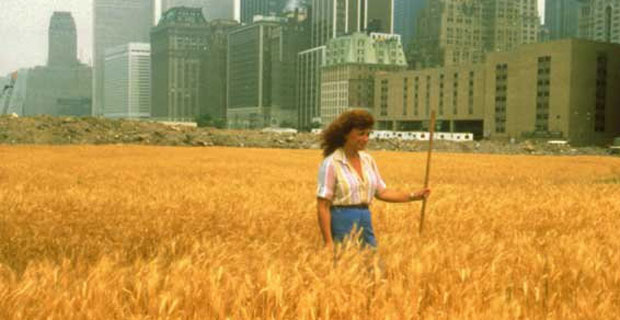
Agnes Denes Fields of Wheat Installation in 1982 (Credit: TwitPic-TruthSeerum via Claudia
BatteryParkCity.com receives many contributions/tips on our site for ideas and current events — and we love it!
Recently we got a true gem of nostalgia. Our Twitter pal TruthSeerum, sent us this picture of Agnes Denes harvesting fields of wheat in 1982.
As we’re preparing for the commemoration of the World Trade Center terror attacks, we’ve made a call out for great memories of our neighborhood before 9/11 and our hopes for the neighborhood in the future. We thought we’d give you the first taste of contributions we’ve received.
If you have a great memory like this, or a personal story about 9/11 please feel free to send it to us at [email protected].
Wheatfield — A Confrontation 2 Acres of wheat planted & harvested, Battery Park landfill, downtown Manhattan summer 1982 (with Statue of Liberty across the Hudson)
After months of preparations, in May 1982, a 2-acre wheat field was planted on a landfill in lower Manhattan, two blocks from Wall Street and the World Trade Center, facing the Statue of Liberty. Two hundred truckloads of dirt were brought in and 285 furrows were dug by hand cleared of rocks and garbage. The seeds were down by hand and the furrows covered with soil. The field was maintained for four months, cleared of wheat smut, weeded, fertilized and sprayed against mildew fungus, and an irrigation system set up. The crop was harvested on August 16 and yielded over 1000 pounds of healthy, golden wheat.
Planting and harvesting a field of wheat on land worth $4.5 billion created a powerful paradox. Wheatfield was a symbol, a universal concept, it represented food, energy, commerce, world trade, economics. It referred to mismanagement, waste, world hunger and ecological concerns. It called attention to our misplaced priorities. The harvested grain traveled to twenty-eight cities around the world in an exhibition called “The International Art Show for the End of World Hungerâ€, organized by the Minnesota Museum of Art (1987-90). The seeds were eventually carried away by people who planted them in many parts of the globe.
Rachel Uchitel’s visit to Ground Zero is too suspicious for me for two reasons:
Was it before or after she found out Tiger Woods had moved to our area that she decided it would be a good idea to exploit Ground Zero for her own fame and fortune?
…and right before the 9th anniversary of 9/11? Why not show support and go with the family of your almost in-laws on the day of?
In an effort to defend her actions, Rachel Uchitel, the now infamous Tiger Woods mistress and former paramour who broke up probably the cutest family I’ve ever seen released a statement:
“Who the f— are people to be talking about me?” Uchitel told the New York Post. “Until they go through what I went through, living with a guy and being engaged to him and having that person dead an hour after waking up next to him. “If people think I’m milking something for the benefit of getting on TV or getting more well-known, I’m already well-known.”
Except that dear Rachel, your 15 minutes were up long ago.
Is this an attempt at public relations triage for us to forget your What is with your timing? Visiting the site right before 9/11? Your almost father-in-law had said during the Tiger Woods debacle that he had not even heard from you since your fiance was buried.
Actions speak louder than words, and your actions sound like nails on a chalkboard.
Exposing yourself to a national audience in your healing process is tantamount to placing shards of glass on an open wound.
Dr. Drew is also to blame.
According to reports, this idea came to them during a pre-taping interview with the Oprah Winfrey show. Thank goodness Harpo Productions had the right mind frame to leave that segment on the cutting room floor.
Just doesn’t feel right. The whole thing. Maybe my sensitivities are up because it is September.
This weekend, I saw someone moving into this ridiculous apartment on Reade Street. Peeking into the place I wondered who was the lucky person who moved into our neighborhood.
I’m sure you’ve heard a lot about the challenging course of Park51, but we’re pretty sure New York became your “hole in one” once you heard about our even more infamous “Ground Zero Strip Clubs!”
There is the Pussycat Lounge on Greenwich or the New York Dolls on Murray Street!
Oh! I’m also sure that since New Yorkers don’t need cars — you won’t have to worry about crashing them in this part of the woods city! There’s always a cab around here somewhere.
Otherwise, we at BatteryParkCity.com offer you a warm welcome (if you are actually our neighbor) and would love to bump into you at the Whole Foods sometime.
Sincerely,
Your speculative Battery Park City and Tribeca neighbors
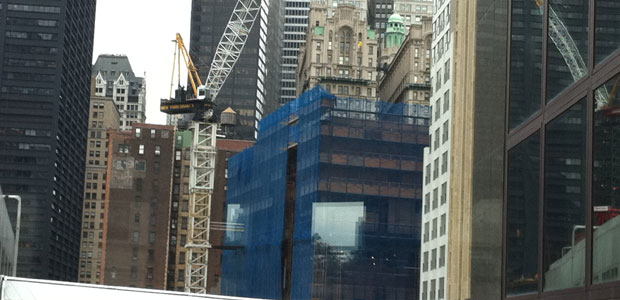
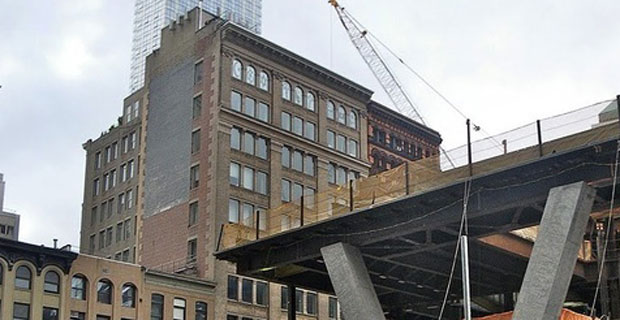
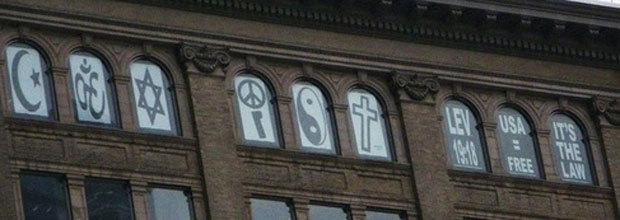
The Deconstruction of the former Deutsche Bank building.
The renaissance of the World Trade Center is coming into its own. As the new buildings carve out their space in the new skyline, there is one building we are happy to see come down.
The former Deutsche Bank building at 130 Liberty Street has been an unfortunate eyesore in the neighborhood for far too long. As fast as things are going up around here, it’s hard to ignore how slowly the building has come down — until recently. After a tough road for the demolition, including allegations of mismanagement, safety issues and the unfortunate deaths of two firefighters, the building is finally on-schedule for complete disassembling.
In June the New York City Department of Buildings approved a new method of demolition for the building that allows for the disassembling of large steel pieces. This new method has improved the process: nearly 20 stories have been deconstructed since last November.
The approval of an “around the clock” schedule has also helped, as construction crews have worked daily on the site from 7am until midnight. The new methods and accelerated schedule have brought about show swift progress in tearing down the last vestige of the 9/11 terror attacks.
As of the end of this month, only 8 stories of the building remain. Demolition is expected to be completed by December 2010/January 2011.
The Winter Garden will go back to it’s original roots as a connection to the World Trade Center.
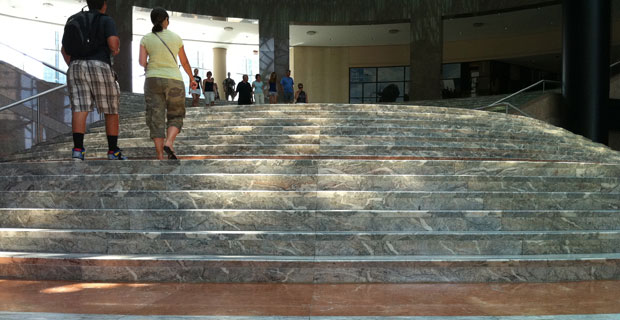
In a move that is set to break hearts in our community, a likely victim will be the beloved World Financial Stairs. After several weeks of speculation and a protest from the SEBC union workers in the World Financial Center, the stairs will be demolished to make way for a connection path from the Fulton Street Transit Hub.
The World Financial Center was connected to World Trade Center mass transportation through the Vesey Street bridge, which was destroyed during the 9/11 terror attacks.
In light of the rebuilding of both the World Trade Center and Fulton Street Transit hub, Brookfield Properties has announced a plan to connect Battery Park City with an underground tunnel. According to Brookfield, keeping the Winter Garden Stairs “would not only create an obstacle between the escalators from the underground tunnel and the Winter Garden, but would also waste a once-in-a-century opportunity to open the interior of lower Manhattan to the waterfront,†according to letter correspondence between Brookfield and City Planning officials according to the Downtown Express.
It is speculated that by eliminating the stairs would also provide increasing retail space in the World Financial Center, increasing revenue for Brookfield Properties.
In July, Community Board 1 officials have put in a formal request that the stairs be preserved. They are often seen as a standing landmark of the terror attacks and also provide unparalleled views of the waterfront. Officials from City Planning as well as Brookfield properties are set to address the demolition of the stairs when the Community Board is back in session in September.
The top of the stairs is currently used by tourists as a prime viewing area of the World Trade Center site.
Residents have been disheartened by news of the potential demolition of the stairs,
“The Winter Garden, and especially the Staircase, has become an iconic symbol of renewal as well as being the most beautiful space downtown,” says Betty Heller on BatteryParkCity.com,“Â Destroying it would be an act of vandalism akin to the destruction of the Pennsylvania Railroad Station. Brookfield has been a remarkably good guardian of this precious space until now. It would be a shame to destroy their reputation.”
It’s quite unbelievable that we are embarking on the 9th anniversary of 9/11.
For years after the attacks, I refused to face Ground Zero while passing south on the West Side Highway.
Partially because it pained me to see the area, but also because I wanted to remember everything that I loved so much about the Twin Towers. Simple memories, like tasting my first Krispy Kreme donut to meeting my high school sweetheart at the Path station.
This time, the road to the anniversary has been paved in controversy surrounding the Park51 center. The political firestorm has overshadowed the progress and positive rebuilding of our area that so many of us are looking forward to.
So, in light of the anniversaries — We’d like for you to share your memories, pre and post 9/11, thoughts and hopes for our neighborhood as we are moving through its metamorphosis.
We’re looking for pictures and stories from our neighbors and community members in our area. We will post as many as we get! Even if it’s only 1 or 2!
This site is as much yours as it is ours here at BatteryParkCity.com and it would be an honor to help share some of your stories with all our readers on the site.
To submit your shared stories, pictures and thoughts please reach out to us:
It has been extremely challenging to cover the deluge of news surrounding our neighborhood in the past few months.
When we started this site, we intended for it to be a community-building place online: a place where we could discuss with pride the rebuilding of the new World Trade Center and the metamorphosis it will surely bring to our area.
However, we could not have anticipated the national response towards the development of the Park51 mosque, a development connected — in ways other than geography — to the greater rebuilding of Lower Manhattan. Issues of ‘fundamental rights’ and ‘racism’ have sprung up, and our readers (and the nation as a whole) remain divided.
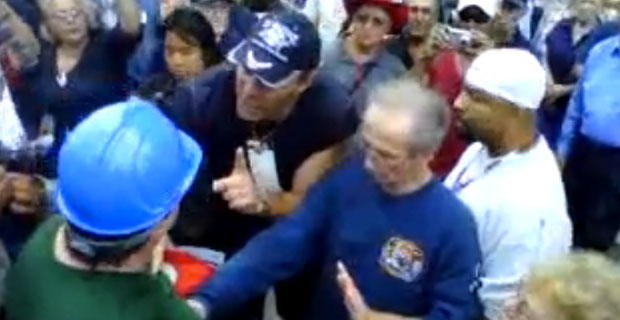
Ideological debates aside, some troubling events from this weekend leave us with another important question:Â How can we be protected and made safe from opponents targeting the mosque in our area?
In the video above (shared with us via Facebook), protesters lambast a person they wrongly believe is a Muslim.
How will the environment and political tension surrounding the mosque change our neighborhood’s safety? Sure, we don’t live on Ground Zero, but this is an area where we walk for our groceries, for our subways and in September, this is the route some of us take to bring our children to school.
I’m not sure if all in the community share the same concerns as some. If the plans for Park51 go through — and they are as iconic as the developers plan — will this mean we as a community should start to get used to constant protests? If so, how long will they last? Who will help to protect residents of Lower Manhattan from the national scrutiny?
These are questions I feel are not being asked enough. I hope that someone out there is concerned not with the political, or the religious, but the safety ramifications this might cause our community.
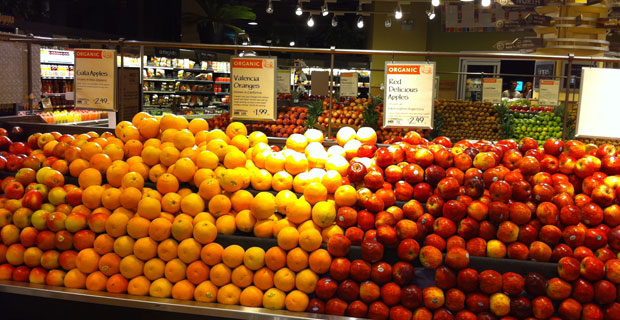
Tribeca Whole Foods is one of several supermarkets in Battery Park City
More often than not one of the following things happens to me at either one of the Gristedes on South End Avenue:
1. I get overcharged egregiously on a single item.
2. I bring home something that is way past its due date.
3. I do not find what I’m looking for at the supermarket.
So when the New York City Department of Consumer Affairs released a damning study that one out of every two supermarkets were found in pricing and tax violations — it was hardly a surprise.
According to their press release today:
“It’s a supermarket’s responsibility to ensure that its products are accurately priced and its customers are correctly charged, but with half the supermarkets in the City receiving violations, it is clear that they are failing their customers,” said Commissioner Jonathan Mintz, “Because thousands of New Yorkers continue to be overcharged, I’ve directed our inspectors to double the number of inspections in the coming year.”
Prices are not reliable at Gristedes
Hallelujah!
Dear. Mr Mintz can you send a couple over in our neighborhood? One for each of the Gristedes? This is something Battery Park City residents have been experiencing for years.
Neighborhood resident and Foursquarer Michelle D. had left a tip after checking into Gristedes,
“Lines are long, cashiers are rude, items are almost always scanned incorrectly versus the sticker or sign prices, items are at times spoiled or stale. I hate this place with a passion.”
This frustration over our supermarket reflects a need for fresh and affordable groceries. It isn’t a case of how our needs are not heard — for the addition of the seasonal greenmarket and to some extent the 24-hour fruit vendor on the corner of Albany street often helps, although in a more renegade style. The inspectors may be the type of regulation we need to help to alleviate this situation.
The supermarkets in violation could face more than $380,000 in fines to the City. These violations include inaccurate check-out scanners, lack of prices on individual items, taxation of items that are not taxable, improperly weighed food, and unavailability of scales for customers.
Also according to the report, the most common violation was lack of item pricing, for items without price tags. This immediately brought me back to Gristedes last week when I purchased a bottle of capers for an astounding $4.99 — for a bottle that is usually $1.99. When I asked the cashier if that was the right price, her response was, “yup.”
Some people may just respond, “Go to Whole Foods” or “Order from Fresh Direct,” it doesn’t seem to be the right answer, although these are both options i frequent. For residents who live on South End Avenue it’s a lose lose situation. By virtue of how estranged our neighborhood is, Gristedes wins — in essence cornering the grocery market, at least south of the Marina.
So although I started this piece on how the report was not a surprise — it is still a welcomed acknowledgement. That is, if we can get one of the inspectors up in our neighborhood…
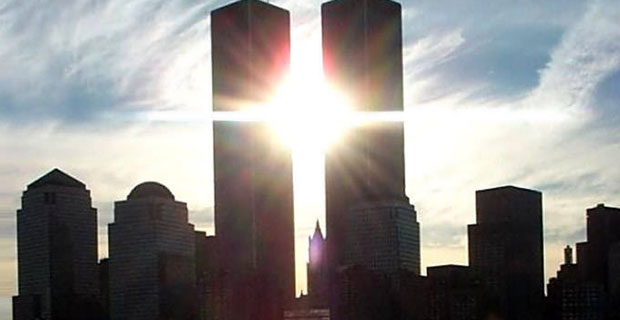
Before Ground Zero earned its capital letters and became the defacto term for the area of the NYC terrorist attacks on 9/11, it simply meant “a scene of great devastation.”
Throughout their existence, the Twin Towers were one of the most revered architectural skyscrapers of their time. Millions flocked to the 110-story observation deck to take pictures, buy t-shirts and mementos. Post 9/11, tourists still flocked to the area: a grotesquely different view that could no longer be called the Twin Towers. “Ground Zero” was a different word for a much-changed, different place.
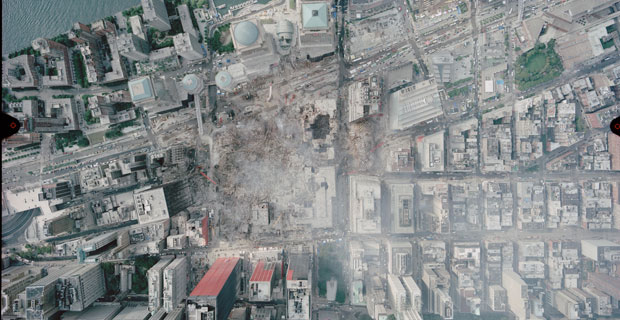
There has been a lot of discussion about what should be considered “Ground Zero.” Putting definitive boundaries is a slippery slope. Here is a list of buildings that were affected by the terrorist attacks on 9/11.
The World Trade Center and its buildings:
1 World Trade Center
2 World Trade Center
3 World Trade Center – Marriott (Former Vista Hotel)
4 World Trade Center
5 World Trade Center
6 World Trade Center
7 World Trade Center
Borough of Manhattan Community College Fitterman Hall after 9/11
Other buildings/structures destroyed or damaged on 9/11:
90 West Street
St. Nicholas Orthodox Greek Church
1 Liberty Plaza Building
Millenium Hotel
Old Post Office Building
BMCC/CUNY Fitterman Hall
Verizon Building
Bankers Trust Building
World Financial Center Bridge
World Financial Center Winter Garden
American Express Building
Merill Lynch Building
Gateway Plaza Complex
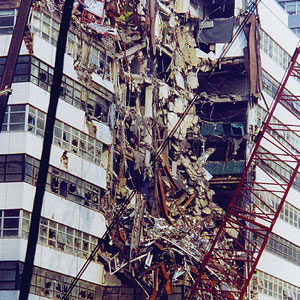
The building which endured damage furthest North of the Twin Towers footprints is the Borough of Manhattan Community College’s Fitterman Hall. The building at 30 West Broadway was destroyed by the collapse of 7 World Trade Center on 9/11. Today, the boundaries of the now demolished building, is not considered “Ground Zero.” Although, from the site of the proposed Park51 center, you can look West at the site where the building used to be. Is it that we implicitly feel the destruction of the CUNY building isn’t part of the boundaries of devastation?
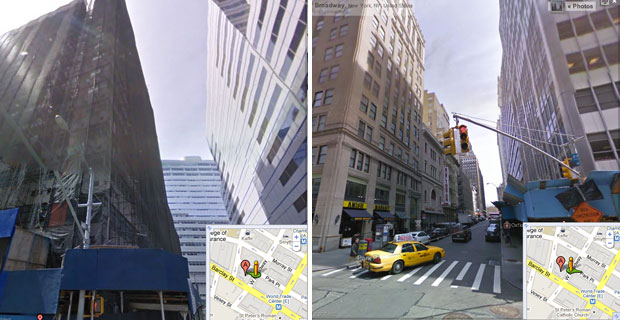
Here is a Google Map look on the corner of West Broadway and Park Place. From a simple turn on the corner you can see the former Fitterman Hall and the former Burlington Coat Factory.
Google Maps capture the corner of West Broadway and Park Place (Credit: Google)
To limit the term “Ground Zero” to the footprints of the Twin Towers automatically diminishes any destruction suffered on 9/11 beyond the chain linked fence that exists today.
To set boundaries means that insensitivities can be easily hurled from both sides of the Park51 debate. Like a game of tag, using the term Ground Zero is tantamount to having a “base” or “being safe.” Is it though?
The term “Ground Zero” should not be leveraged on either side to discuss who is right and who is wrong.
Residents of Battery Park City who were displaced and had to flee the neighborhood because of air and water concerns are also victims of the events that occurred at Ground Zero — although hardly recognized as such.  Many residents did not have homes to return to that day, could not return until their buildings were deemed safe. Devastation of businesses, houses of worship and homes were widespread in areas not colloquially considered “Ground Zero.” Does that make their experience post 9/11 any less important or less part of that scene?
To limit “Ground Zero” — which generically means “a scene of great devastation” — to just the footprints of the Twin Towers is a great disheartenment and disservice to the survivors of the attacks: the residents, businesses, schools and those who have endured to rebuild this community. Just ask anyone who lived in Battery Park City at that time. If the Cordoba Initiative wants to be part of the rebuilding, acknowledging instead of denying they are a community center at “Ground Zero” would be a first step in a good direction. Wouldn’t it be an honor to be part of rebuilding Ground Zero? After 9 years of almost inaction at the site, anyone who wants to improve on our community should be welcomed.
Perhaps the next step is to teach America and beyond that “Islam,””Muslims” and “mosque” are not dirty words.